Cribbage rules: how to play
Cribbage is a two-player card game in which you score points for card combinations (fifteens, pairs, runs and flushes) first while playing cards alternately up to a count of 31, and then by counting your hand against a shared cut card. The first player to peg 121 points wins. Each deal has three phases: the discard, where both players throw two of their six cards into a bonus hand called the crib; the play, where cards are laid alternately without passing 31; and the show, where both hands and the crib are counted.
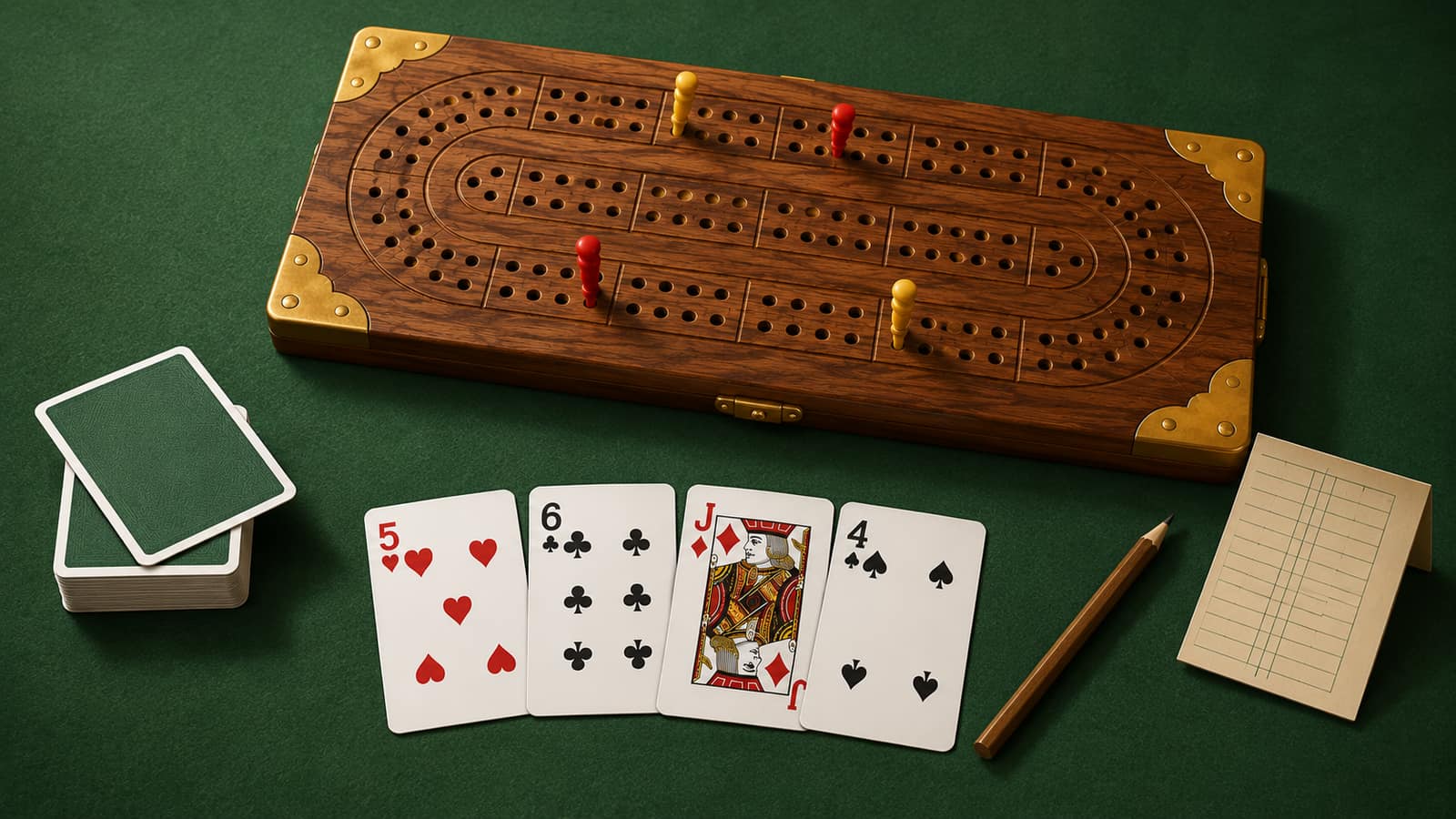
Setup and the deal
You need a standard 52-card deck and a cribbage board (or this page, since the game above tracks the pegging for you). The dealer alternates every hand, and dealing is an advantage because the dealer owns the crib.
Cut for first deal
Both players cut the deck; the lower card deals first. Ace is low. The deal alternates every hand for the rest of the game.
Deal six cards each
The dealer shuffles and deals six cards to each player, one at a time, starting with the opponent (the "pone").
Throw two cards to the crib
Each player chooses two cards from their six and places them face down in a shared pile called the crib. The crib belongs to the dealer and is counted at the end of the hand, so throw generously to your own crib and cautiously to your opponent’s.
Cut the starter card
The pone cuts the remaining deck and the dealer turns the top card of the lower half face up. This is the starter (or "cut"). If it is a jack, the dealer immediately pegs 2 points, called "his heels".
The play (pegging)
Starting with the pone, players alternately lay one card face up, announcing the running total of card values. The total may never pass 31. Aces count 1, face cards count 10.
- Bringing the count to exactly 15 pegs 2 points; exactly 31 pegs 2 points.
- Pairing the previous card pegs 2. A third card of the same rank pegs 6 (pair royal); a fourth pegs 12.
- Completing a run of three or more pegs 1 point per card. The run cards need not be played in order, so 7, then 5, then 6 pegs a run of three, but the run must be unbroken by any other card.
- If you cannot play without passing 31, you say "go". Your opponent keeps playing while able, then pegs 1 for the go (or 2 if they reach exactly 31). The count resets to zero and the player who did not play last leads.
- Playing the very last card of the hand pegs 1 ("last card"), unless it makes 31, which already pegged 2.
Do runs have to be in order during pegging?
- No. Runs during the play may form in any order as long as they are unbroken: 3, then 5, then 4 pegs a run of three because the last three cards can be arranged as 3-4-5. A duplicate rank or an unrelated card breaks the run.
Can you score a flush during pegging?
- No. Flushes count only in the show, when hands are counted. During the play, only fifteens, thirty-ones, pairs, runs, goes and last card score.
The show: counting the hands
When all eight cards are played, the hands are counted, always in this order: the pone’s hand first, then the dealer’s hand, then the crib. Each is counted as five cards: the four held plus the shared starter. In a close game the counting order decides the winner, because the game ends the instant anyone reaches 121.
| Combination | Points | Notes |
|---|---|---|
| Fifteen: any set of cards totalling 15 | 2 each | Count every distinct combination |
| Pair | 2 | Three of a kind is 3 pairs = 6; four of a kind is 6 pairs = 12 |
| Run of 3 / 4 / 5 | 3 / 4 / 5 | A pair inside a run doubles it: 4-5-5-6 is two runs of three |
| Flush: four hand cards of one suit | 4 | Plus 1 if the starter matches. In the crib, only a five-card flush counts |
| His nobs: jack matching the starter suit | 1 | The jack held in hand, not the starter itself |
| His heels: starter is a jack | 2 | To the dealer, pegged immediately at the cut |
The highest possible hand is 29: three fives and the jack of the starter suit, with the fourth five as the starter. The totals 19, 25, 26 and 27 are mathematically impossible, which is why "a nineteen hand" is cribbage slang for scoring nothing. Use the hand calculator to count any hand and see exactly which cards make each combination.
Winning, skunks and muggins
- The first player to 121 points wins immediately, even in the middle of counting a hand. The remaining hands are never counted.
- If the loser has not reached 91, they are skunked, which counts as a double loss in match play. Under 61 is a double skunk.
- Muggins (optional, and playable here): a player who undercounts their hand keeps only what they announced, and the opponent may claim the points they missed by calling "muggins".
Crib and cribbage are the same game
Crib is cribbage. The short form is the ordinary name for the game across Britain and Canada, and everything on this page applies to it unchanged: same board, same 121 points, same count. If you searched for crib rules and landed here, you are in the right place.
The word does double duty, which is the only thing that makes it confusing. Cribbage is the game; the crib is the four-card bonus hand the dealer counts last, built from the two cards each player throws away. So a sentence like "I won at crib because the crib had a flush" is not a typo. Where a rule below depends on which one is meant, this site says "the crib" for the extra hand and "cribbage" for the game.
Regional habits vary beyond the name. In parts of Canada and New England the crib itself is called the box or the kitty, and five-card cribbage still runs in British pub leagues in South Wales, Hampshire and Surrey, while the six-card game is standard everywhere else. None of that changes how a hand is counted.
Cribbage terms
Crib
- The extra four-card hand formed by each player’s two discards. It belongs to the dealer and is counted last, after both hands.
Pone
- The non-dealer. The pone leads the first card of the play and counts their hand first in the show.
Pegging
- Both the play phase itself and the act of scoring points by moving pegs along the board. Each player uses two pegs, leapfrogging so the rear peg always shows the previous score.
Go
- What you say when you cannot play a card without taking the count past 31. Your opponent pegs 1 point for the go once neither of you can play.
His nobs
- A jack in your hand of the same suit as the starter card, worth 1 point in the show.
His heels
- A jack turned as the starter card, worth 2 points to the dealer, pegged immediately.
Muggins
- An optional rule: if a player undercounts their own hand, the opponent may call "muggins" and claim the missed points for themselves.
Skunk
- Winning while your opponent is still below 91 points. In match play a skunk counts as two game wins; below 61 is a double skunk.
Nineteen
- Slang for a hand worth zero, because 19 is a total no cribbage hand can actually score. The other impossible totals are 25, 26 and 27.
Starter
- The card cut face up after the discard, also called the cut card. It counts as a fifth card in every hand and in the crib.
Frequently asked questions
How many cards do you deal in cribbage?
- Six cards each in the standard two-player game. Both players discard two to the crib, leaving four in hand. Older six-card variants and three- or four-player games deal five.
What is the best hand in cribbage?
- The perfect 29: three fives and the jack of the same suit as the starter, with the fourth five cut as the starter. It scores eight fifteens (16), six pairs (12) and his nobs (1). The odds are about 1 in 216,580 hands.
Does a four-card flush count in the crib?
- No. In the crib, a flush only scores when all five cards (the four crib cards and the starter) share a suit, for 5 points. In a hand, four matching cards score 4, or 5 if the starter matches too.
Who counts first in cribbage?
- The non-dealer (pone) always counts first, then the dealer’s hand, then the crib. This matters at the end of the game: a pone who reaches 121 wins before the dealer ever gets to count.
Is crib the same game as cribbage?
- Yes. Crib is simply the short name, used as standard in Britain and Canada. The rules, the board and the 121-point target are identical, so crib rules and cribbage rules mean the same thing. Confusingly the crib is also the name of the dealer’s four-card bonus hand.
What is the old name for cribbage?
- Noddy. Cribbage is a 17th-century derivation of it, credited to the English poet Sir John Suckling, and noddy itself is now a historical game that is rarely played.
Do you have to get exactly 121 in cribbage?
- No. The game ends the moment a player reaches or passes 121, so pegging 2 points from 120 wins outright. There is no need to land on the number exactly and no penalty for overshooting it.
Why do cribbage players say "fifteen two, fifteen four"?
- Each combination totalling fifteen scores 2 points, and players call the running total as they count: "fifteen two, fifteen four, and a pair is six". The hand calculator on this site speaks any hand this way.
Sources
These rules follow the American Cribbage Congress rules of play (cribbage.org) and the Bicycle / United States Playing Card Company rule sheet. Where casual and tournament practice differ, as with muggins and match scoring for skunks, the difference is noted rather than silently picking one.